Walk through almost any building and you'll pass a few different fire extinguishers. Most of them are red, most of them look about the same, and most people figure one is as good as another. They aren't. Each type holds a different agent, and each one puts out a fire in a different way. To see why that matters, it helps to start with what a fire actually is.
What a fire needs
A fire needs three things at the same time. It needs fuel, which is anything that will burn. It needs heat, enough to get it going. And it needs oxygen, which is usually just the air around it. People call that the fire triangle. Once a fire is going, there's also a chemical chain reaction between those three that keeps feeding itself.
Take away any one of those and the fire goes out. That's all an extinguisher is doing. Some cool the fuel down until it won't burn anymore. Some cover the fuel or push the oxygen away from it. Some break the chain reaction. Which one works depends on what's burning.
What's burning: the classes
Fires are sorted into classes by what's burning, and every extinguisher label tells you which classes it's rated for.
- Class A is ordinary stuff like wood, paper, cardboard, cloth, trash, and a lot of plastics.
- Class B is flammable liquids and gases, like gasoline, oil, grease, paint, solvents, and propane.
- Class C is anything electrical that's still powered.
- Class D is burning metal, like magnesium, and it takes its own extinguisher.
- Class K is cooking oil and fat in a commercial kitchen.
That's the short version. Our classes of fires article goes deeper.
The types you'll see
Water. A pressurized water extinguisher cools a Class A fire, and that's all it's for. Never use water on a grease fire, a flammable liquid, or anything electrical. On grease it can splash the burning oil around, and on live electrical it can carry current back to you.
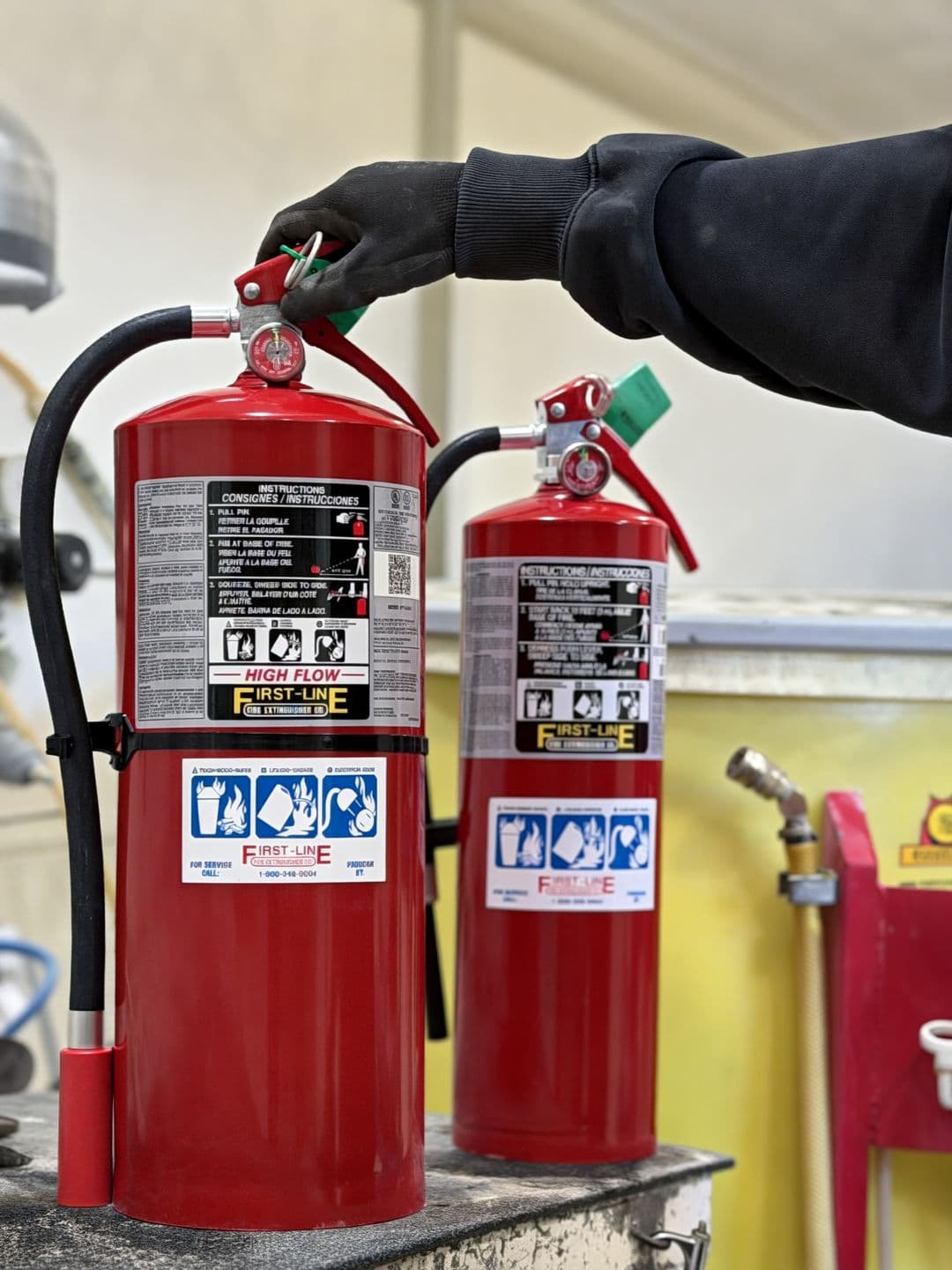
Multipurpose dry chemical (ABC). This is the one on most walls. It's full of a fine yellow powder called monoammonium phosphate that breaks the chain reaction and knocks the flames down fast. On wood and paper, the powder melts and coats the surface, which helps keep it from flaring back up. It's rated for Class A, B, and C, so it covers ordinary fires, flammable liquids and grease, and electrical fires. The tradeoff is the mess. The powder gets everywhere, and it's hard on electronics.
BC dry chemical. These use sodium bicarbonate or potassium bicarbonate instead. They work well on flammable liquids and electrical fires, but they aren't rated for wood and paper. You'll see them in some shops and garages. Potassium bicarbonate, which a lot of people call Purple K, is common where fuel is the main hazard.
Carbon dioxide (CO2). A CO2 extinguisher has a big horn on the end and no gauge, so the only way to know what's in it is to weigh it. The CO2 comes out as a cold gas that pushes the oxygen away from the fire. It's rated for Class B and C, and it leaves nothing behind, which is why you'll see it around electrical equipment. It doesn't do much outside in the wind. And in a small, closed room, the gas that pushes oxygen away from the fire pushes it away from you too.
Wet chemical (Class K). This is the one by the fryers in a commercial kitchen. It sprays a fine mist that reacts with hot cooking oil and turns the top of it into a soapy layer that holds the fire down while the oil cools. A kitchen with a hood system still needs one. Pull the hood system first and let it go, then use the K if there's still fire.
Clean agent. These spray an agent that turns to gas and leaves no residue, so they make sense around computers and equipment that powder would ruin.
Dry powder (Class D). This is made for burning metals, like magnesium and titanium, in machine shops and labs. It does one job, and you'll only see it where that metal is.
Foam. Foam extinguishers lay a blanket over a burning liquid to keep the air off it. They work on ordinary fires too, but they're less common in regular buildings.
What about lithium batteries?
A lithium-ion battery isn't one of the letter classes on an extinguisher. An ABC can knock down the flame on the outside of a pack, but it doesn't cool the cells inside, and the pack can flare back up. Treat a lithium pack as its own problem. We wrote that up in what fire extinguisher works on a lithium-ion battery fire.
Matching the extinguisher to the spot
Most buildings start with ABC extinguishers, because they cover most of what can catch fire in a regular building. Then the special spots get what they need. That might be a Class K by the cook line, something without powder near sensitive electronics, or a bigger unit where fuel is stored. We match the extinguisher to the hazard. When we walk your building, we look at what's actually around each extinguisher, and we'll tell you if one is the wrong type for where it's hanging.
The right type still has to work when somebody grabs it. That means somebody looks at it every month, and a trained tech inspects and services it every year. We leave a report. We keep up with the date.
If you want somebody to walk your building and make sure the right extinguishers are in the right spots, call 1-800-348-9604.